Staring at a shelf of glues and unsure which to trust with your cards? The best glue for paper crafts is usually a PVA craft glue, with a glue stick for light jobs and archival-labelled glue for keepsakes.
This guide sits alongside our look at paper cutting tools, because clean cuts and clean glue work go together.
| Item | Key fact |
|---|---|
| PVA in use since | c. 1920 to present |
| PVA appearance once dry | Dries clear |
| PVA acidity | Acidic in woodworking and school glue; acid-free in archival products |
| Starch paste behaviour | Water-soluble and reversible |
| Common starches for paste | Rice and wheat |
These figures come from the University of Illinois preservation guide to adhesives. They can change, so check the source before you rely on them.
What makes a glue good for paper?
Paper is thin and absorbent, so a good paper glue grips quickly without soaking through. It should also dry flat, without warping the sheet or leaving a shiny patch.
Think about four qualities before you buy:
- Tack: how fast the glue grabs, which matters when you cannot hold a piece for long.
- Working time: how long you can slide a piece into place before it sets.
- Moisture: wet glues can cockle thin paper, while dry adhesives do not.
- Ageing: whether the glue stays clear and quiet for years or turns yellow.
No single glue wins on all four. That is why most crafters keep two or three on the desk.
PVA glue: the all-round choice
Polyvinyl acetate, or PVA, is a white liquid that dries clear. The preservation guide dates it to around 1920 onward, and it is now the basis of most craft glues. You can read its description on the University of Illinois adhesives page.
It suits layering cardstock, mounting panels onto card bases and gluing paper to chipboard. Because it is water-based, spread it thinly. A fine brush, a spreader or a cut-up piece of scrap card all work well.
For heavier sheets, check the cardstock weight guide to see how much glue each weight needs. Use a thin, even layer on cardstock and an especially light application on thin paper.
Is all PVA safe for paper?
No. The same guide notes that polyvinyl acetate turns up in acidic products such as woodworking glue and school glue, and also in acid-free, archival products.
For a card that will be tossed in a recycling bin next year, that hardly matters. For a wedding card, a photo mount or a memory book, look for a label that says acid-free or archival, and keep woodworking glue for wood.
Glue sticks, tape and other options
Each adhesive has a place. Use this list to match the job:
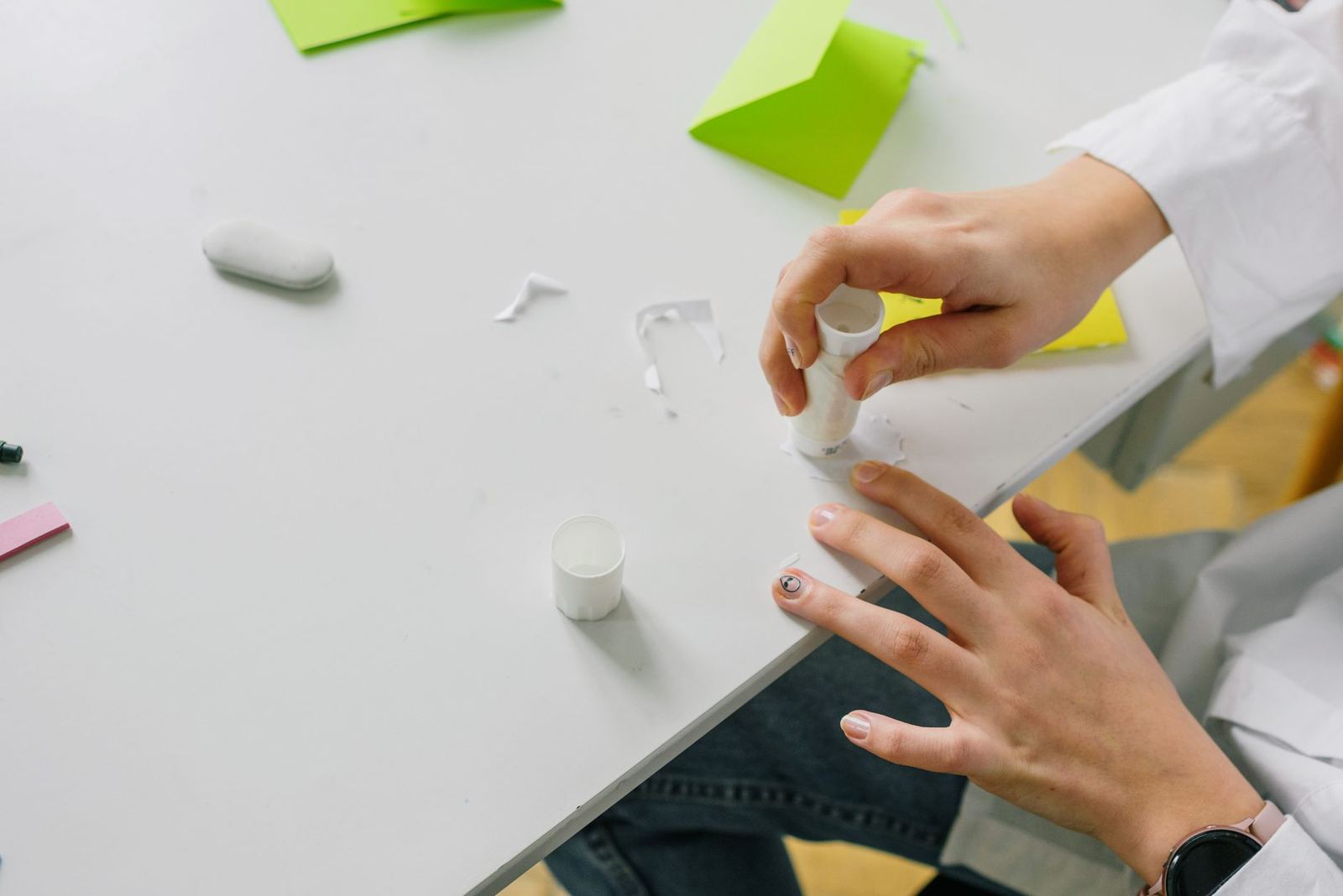
- Glue stick: best for light paper, envelopes and quick collage, and gentle on thin sheets.
- Double-sided tape: neat for straight edges and sentiments, with no drying time.
- Foam squares: add lift and shadow to layered cards, and they are not meant to hold alone on heavy pieces.
- Liquid glue pens: let you place tiny punched shapes with accuracy.
- Hot glue: fine for rigid decorations, but too bulky and hot for most paper.
Be wary of old tape on anything you want to keep. The preservation guide shows yellow staining from deteriorated tape adhesive migrating into the paper, and it notes that rubber-based adhesives yellow and become oily and sticky as they break down. Details are in the same guide.
Starch paste for reversible work
If you want to be able to undo a join, starch paste is the traditional answer. According to the preservation guide, starch pastes are water-soluble and reversible, which is why they are common in paper conservation.
The most common starches are rice and wheat. Paste is slower and wetter than PVA, so it suits mounting flat artwork, hinging prints and repairing torn paper rather than quick card building.
A bone tool helps press joins flat, but can leave shiny burnishing marks; test on scrap first. Our bone folder uses page shows how to burnish a bonded edge.
Matching the glue to your project
The right choice depends on what the piece is for and how long it needs to last. A quick birthday card asks for something different from a scrapbook page.
- Everyday cards: a standard PVA or a glue stick is plenty, and double-sided tape keeps edges tidy.
- Keepsake cards and albums: an acid-free or archival-labelled PVA, or a dry adhesive with the same label.
- Paper flowers and dimensional shapes: a thicker PVA that grabs fast, so petals hold their curve while drying.
- Delicate tissue and vellum: a very thin layer of paste or a clear-drying liquid, tested on scrap first, because vellum shows every smear.
- Prints you may want to lift later: starch paste, since it is reversible.
When in doubt, pick the gentlest option that will hold. Stronger glue is not better if it warps the paper or cannot be adjusted.
Common mistakes to avoid
Most glue problems come from using too much, not from using the wrong brand. A heavy layer soaks into the fibres, leaves a rippled surface and takes far longer to dry.
Another frequent slip is using a glue meant for another material. Woodworking glue and school glue may be acidic, so keep them away from pieces you plan to keep. Finally, do not leave glue sticks uncapped, as they dry out and crumble.
If a join fails, gently separate any loose areas without tearing the paper, remove loose adhesive and reapply an even coat according to the glue’s instructions. Re-gluing over a wet or lumpy layer rarely holds.
Tips for a clean, flat result
- Test the glue on a scrap of the same paper first.
- Apply a thin, even layer, working from the centre out to the edges.
- Press the piece down and wipe off squeezed-out glue straight away.
- Weigh the work under a clean book until dry to stop curling.
- Close the cap tightly after use so liquid glue does not skin over.
Work on a sheet of baking paper or scrap paper so stray glue never sticks your project to the table. Swap the scrap sheet whenever it gets tacky, and wash your hands or spreader between colours of card so no smudges transfer.
Keep a damp cloth and a dry cloth nearby. Wet glue wipes off easily, but dried glue marks can show on dark or coloured card.
Frequently asked questions
Is school glue fine for cardmaking?
Show answer
For cards that are not meant to be kept long term, yes. The preservation guide lists school glue among the acidic PVA products, so choose an acid-free label for keepsakes.
Which glue will not wrinkle thin paper?
Show answer
A dry adhesive such as double-sided tape avoids adding moisture; use glue sticks sparingly and test on scrap first. With liquid glue, spread a very thin layer.
Can I undo a glued join?
Show answer
Starch paste is described as water-soluble and reversible, so it is the best choice if you may need to undo a join. PVA is generally permanent once dry.
Does tape damage paper over time?
Show answer
It can. The preservation guide shows tape adhesive staining paper yellow as it deteriorates, so avoid tapes of unknown composition or unsuitable for archival use on pieces you want to last.