Made a card that fits no envelope in the shop? Here is how to make an envelope in minutes: measure your card, trace a template onto paper, fold the flaps and glue the sides.
This guide is part of our card making series.
| Item | Value |
|---|---|
| A2 envelope size | 4.375″ × 5.75″ |
| Largest card for an A2 envelope | 4.25″ × 5.5″ |
| A6 envelope size | 4.75″ × 6.5″ |
| A7 envelope size | 5.25″ × 7.25″ |
| Suggested printer paper weight for folded envelopes | 20-24 lb |
Sizes come from Smartpress’s envelope size guide, and the paper weight from a printer-paper envelope tutorial. Figures can change, so check the sources before you rely on them.
Why make your own envelope?
A handmade card often ends up in an odd size, such as a square or a tall slim shape. Shop envelopes rarely fit those, and a custom envelope solves the problem with paper you already own.
It is also a chance to match the envelope to the card. Patterned scrapbook paper, a sheet of kraft or a page of old sheet music can all become something that looks planned rather than improvised.
If you are still choosing the size of your card, our guide to standard card sizes shows which formats suit ready-made envelopes. Making your own is the fallback for everything else.
What you need before you start
The kit is small, and most of it is probably in your craft drawer.
- Paper: lightweight text paper, wrapping paper, scrapbook paper or a plain printer sheet.
- Card stock for a reusable template.
- A ruler, a pencil and a bone folder or the back of a spoon for sharp creases.
- Scissors, or a craft knife with a straight edge and a cutting mat.
- Paper glue or double-sided tape.
Paper choice matters more than most people expect. One tutorial recommends plain, uncoated printer paper weighing around 20-24 lb because it folds cleanly without tearing, according to that printer-paper guide. Heavy card stock can crack on the folds, especially without scoring, so lighter paper is easier for envelopes.
Choose the right envelope size for your card
An envelope should be slightly larger than the card so it slides in without catching. Smartpress lists the common A-series envelopes with the largest insert each one takes.
- A2: 4.375″ × 5.75″ envelope for cards up to 4.25″ × 5.5″.
- A6: 4.75″ × 6.5″ envelope for cards up to 4.5″ × 6.25″.
- A7: 5.25″ × 7.25″ envelope for cards up to 5″ × 7″.
The gap is small, so measure your finished card after it is glued and decorated. Layers and embellishments add bulk, and a card that fit on paper may not fit once it is dressed up.
New to card sizing? Our page on card making for beginners explains how to pick a size before you cut anything.
How to make an envelope with a template
A template gives you a repeatable shape, which is ideal when you need several matching envelopes. One tutorial from All Things Paper suggests printing the templates onto card stock so they are sturdy, durable templates, as that guide explains.
The classic envelope shape is a kite, or diamond, with four flaps. You can draw your own with a simple method.
- Place your finished card diagonally in the middle of a square sheet, with the corners of the sheet pointing to the card’s edges.
- Choose a sheet large enough for the side flaps to meet or overlap, then fold them inward, leaving a little clearance around the card.
- Fold the bottom corner up over the card, and crease it.
- Unfold the sheet, trace its outer edges onto card stock, and copy the crease positions to make a reusable template.
- Cut out the shape and keep it as your template on card stock.
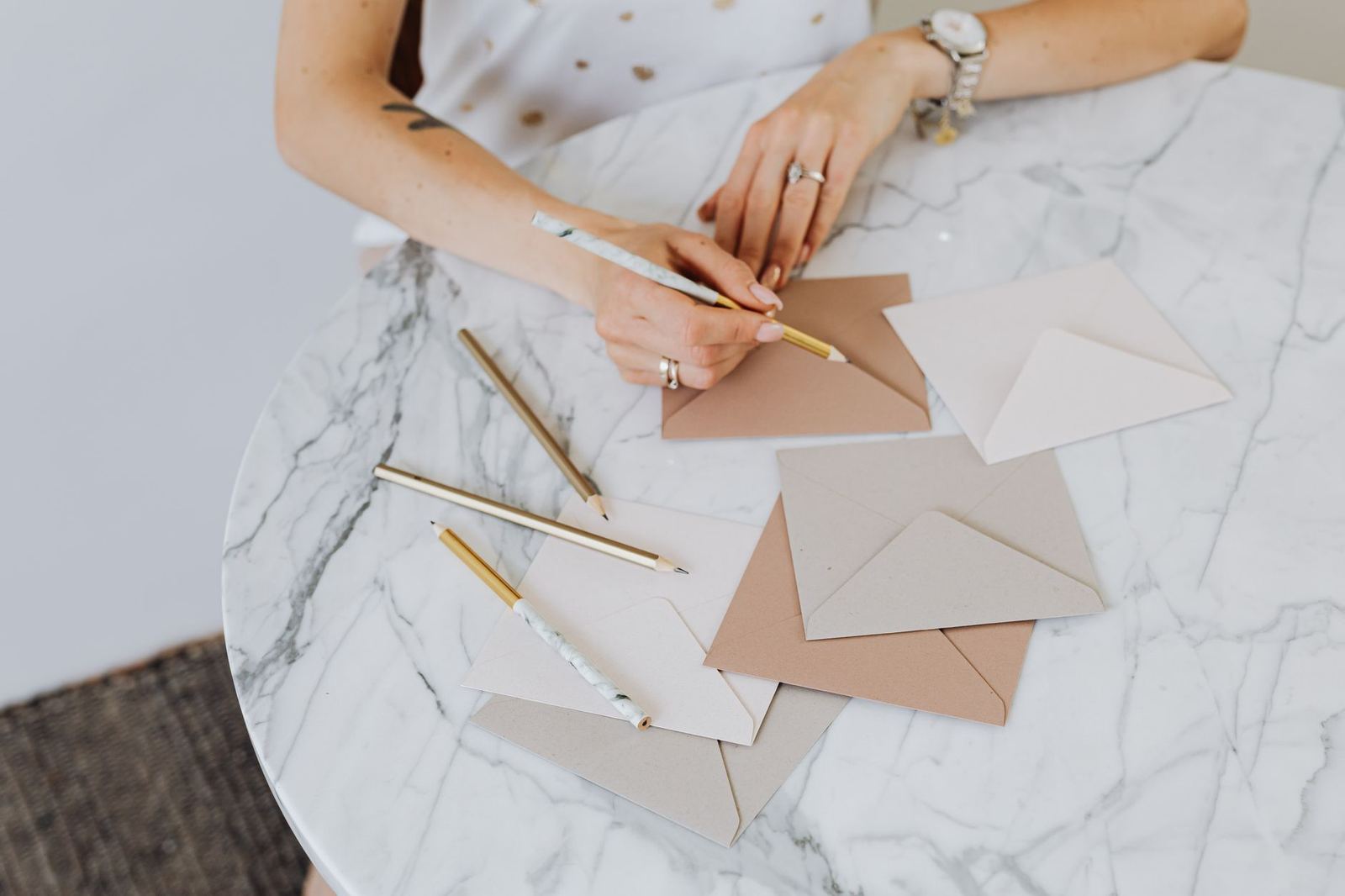
For every new envelope, trace the template onto your chosen paper and cut along the outline. Mark the fold lines lightly in pencil, or score them with a bone folder and ruler so the creases land exactly where you want them.
Fold and glue the envelope
Once the shape is cut, the assembly takes only a minute. Work on a clean, flat surface so the paper does not shift.
- Fold the two side flaps in towards the centre and press each crease flat.
- Fold the bottom flap up over the side flaps.
- Run a thin line of glue along the edges where the bottom flap overlaps the sides, then press firmly.
- Leave the top flap open, slide the card in, and then close the flap.
- Seal with a sticker, a dab of glue or a little tape when you are ready to send it.
Go lightly with the glue. Too much wets the paper and leaves wavy edges, while a thin line of tape gives a flat and tidy seam.
The finished envelope looks best when it is pressed. As the printer-paper tutorial notes, you can flatten the envelope under a heavy object for a crisp, polished finish, which is easy to do with a stack of books.
Folding an envelope from one sheet, no template
If you do not have a template, a single sheet of paper can be folded into an envelope. The tutorial from Abrams Artists starts by folding the paper diagonally and horizontally to mark the center creases precisely.
The same guide then has you fold the long sides and short edges toward the center crease, sharpening each fold for neat flaps. It is quick, and it suits a small letter or a flat card.
The trade-off is accuracy. A folded sheet gives you whatever size the paper allows, so it works best for cards you can trim to match.
Tips for neat, professional results
- Score before you fold. A scored line gives a straight crease, even on thicker paper.
- Cut with a sharp blade. Dull scissors chew the edges, and a craft knife with a straight edge gives clean lines.
- Make a test envelope from scrap paper first, so you can fix the size before cutting your good sheet.
- Line the inside with a contrasting paper for a small surprise when the flap lifts.
- Keep the patterned side outward on the flap, so the design shows when the envelope is closed.
- Check the posting rules of your local postal service for size limits before you mail a handmade envelope.
Keep your finished template in a folder and label it with the card size it fits. Next time you make a card, you will already have the envelope pattern ready.
Frequently asked questions
What paper is best for making an envelope?
Show answer
Lightweight, smooth paper folds best. A tutorial suggests plain, uncoated printer paper of around 20-24 lb, and thin scrapbook or text paper also works well.
How big should the envelope be compared with the card?
Show answer
Slightly larger. For example, an A2 envelope measures 4.375″ × 5.75″ and fits a card up to 4.25″ × 5.5″, according to Smartpress.
Can I make an envelope without a template?
Show answer
Yes. Fold a single sheet by creasing the center lines, then fold the sides and edges toward the center. A template is better when you need matching sizes.
Should I use glue or tape?
Show answer
Either works. Glue gives a hidden seam, while double-sided tape is cleaner and does not wrinkle thin paper.