Curious about kirigami but unsure how it differs from origami? It is paper art where you cut as well as fold, usually starting from a folded sheet, and you can try it with scissors and scrap paper.
Kirigami sits within the wider world of papercraft, and this guide covers its meaning, basic method and practical tips.
| Item | Value |
|---|---|
| Meaning of the word | Kiri means cut, kami means paper |
| English term coined in | 1962 (Florence Temko’s book) |
| Glue | Typically not used |
| Typical starting point | A folded base that is later unfolded |
| Simple designs | Usually symmetrical, such as snowflakes |
These facts come from the Wikipedia kirigami entry. Descriptions of craft traditions can change, so check the source before you rely on them.
What kirigami actually is
The word joins two Japanese terms: kiri for cut and kami for paper. In kirigami the paper is cut as well as being folded, which gives a design that can stand away from the page.
That is the main difference from origami, where the sheet is folded and normally left uncut. Kirigami starts with a single piece of paper that is then cut, rather than being assembled from several parts.
In the United States the term was popularised by Florence Temko, whose 1962 book was titled Kirigami, the Creative Art of Paper cutting. The book did well enough that the word became the Western name for the art of paper cutting.
How the basic method works
Most kirigami begins with a folded base. You cut into the folded paper, then unfold it, open the cuts and flatten the sheet to reveal the finished design.
This is why simple kirigami is usually symmetrical. Every cut you make through the folded layers is repeated across the sheet, so one small snip turns into a pattern.
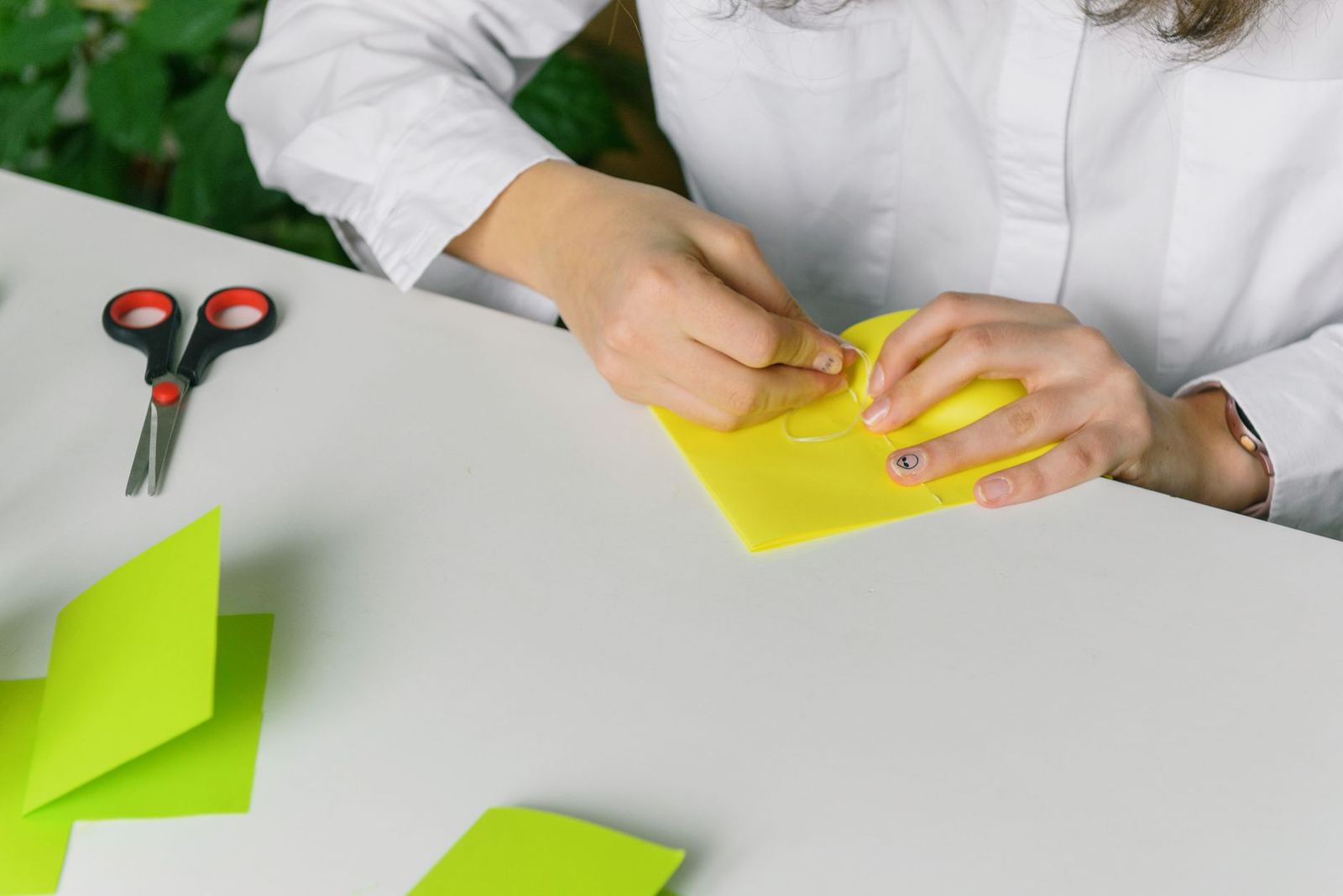
Snowflakes, pentagrams and flower blossoms are the classic first projects because they teach the fold-cut-unfold rhythm with very little risk.
Materials and tools you need
You do not need a special kit. A small set of everyday items is enough to begin.
- Thin, crisp paper that folds cleanly, such as origami paper or printer paper
- Sharp, small scissors for curves and fine detail
- A craft knife and a cutting mat for straight, precise cuts
- A pencil and ruler for planning your lines
- A bone folder or the edge of a ruler for sharp creases
Because kirigami typically does not use glue, your tools matter more than adhesives. Sharp blades give clean edges, and blunt ones tear the paper.
A simple first project: a folded paper snowflake
This is a gentle way to practise the technique. Use a square sheet and scrap paper first so you can make mistakes freely.
- Fold the square in half diagonally to make a triangle.
- Fold the triangle in half again, then in half once more to make a narrow triangular wedge.
- Trim the open end so the edge is neat.
- Cut small notches, curves and triangles along both sides, leaving some of each fold intact.
- Unfold slowly, opening the cuts and flattening the sheet with your fingers.
Leave the fold lines partly uncut. If you cut all the way across a fold, that piece falls away and the design can come apart.
Tips for cleaner cuts
Plan your design with a pencil sketch on the outer layer before you cut. Mark which areas to remove and which to keep, so you do not lose a hinge by accident.
Cut slowly through folded layers and turn the paper, not the scissors, on curves. Thick folded stacks are harder to cut, so choose lighter paper while you learn.
When your cuts feel steady, try asymmetrical pieces, cards with pop-up elements or layered scenes. Paper skills carry over well between crafts, so you might also enjoy how to make paper flowers or paper mache for beginners once you want a different texture to work with.
Common mistakes to avoid
- Folding too many layers, which makes cuts ragged and the unfolding stiff.
- Cutting through every fold, which separates the design into loose pieces.
- Using dull scissors, which crush the paper rather than slicing it.
- Rushing the unfold, which tears thin connecting strips.
If a piece tears, keep it anyway. Many makers mount their work on a contrasting background, which hides small flaws and makes the pattern stand out.
Kirigami compared with origami and other paper cutting
People often use these terms loosely, and sources differ on where one ends and the next begins. A useful rule of thumb is to ask what the paper is allowed to do.
- Origami relies on folding, and the sheet is normally left uncut.
- Kirigami combines folds with cuts, often starting from a folded base.
- General paper cutting covers any design made by removing paper, whether or not folds are involved.
Treat the labels as guides rather than strict categories. What matters for your own projects is the result: a flat cut-out, a pop-up shape or a symmetrical pattern.
Choosing paper for kirigami
Paper choice changes the whole experience. The right sheet folds neatly, cuts cleanly and holds its shape once opened.
Lightweight paper is best for folded designs such as snowflakes, because many layers still cut easily. Heavier card suits designs that need to stand up, such as pop-up cards, but it should be scored before folding so the crease stays sharp.
Colour matters too. A bold sheet on a pale background shows off fine cuts, while patterned paper can hide them. For your first attempts, plain paper makes mistakes easier to spot and learn from.
Project ideas once you are comfortable
After a few snowflakes, you can use the same fold-and-cut thinking for other makes. Keep each project small at first so you can adjust your technique.
- Greeting cards with a cut-out window that frames a coloured layer behind it.
- Paper garlands made from a long strip folded concertina-style, then cut with a repeating shape.
- Window decorations in seasonal shapes, mounted on a plain background.
- Layered wall art with several cut sheets stacked over contrasting colours.
- Gift tags and decorative toppers cut from leftover card.
Because kirigami can be made from a single sheet, it also works well as a low-cost activity for classrooms, clubs and family craft afternoons. Keep scissors for children blunt-tipped and supervise any use of craft knives.
Looking after your finished pieces
Cut paper is delicate, so a little care helps your work last. Flatten finished pieces under a clean book for a short while if they curl after unfolding.
To display a piece, mount it on a contrasting sheet with a small amount of adhesive at the edges, or slip it into a frame with a mount. Keep it away from damp areas and strong direct sunlight, which can fade coloured paper and weaken thin cuts over time.
Frequently asked questions
Is kirigami the same as origami?
Show answer
No. Origami is mainly folding, while kirigami adds cutting. In kirigami the paper is cut as well as folded.
Does kirigami use glue?
Show answer
Kirigami typically does not use glue, since the design comes from one cut sheet of paper.
What does the word kirigami mean?
Show answer
It comes from the Japanese kiri, meaning cut, and kami, meaning paper.
What is a good first kirigami design?
Show answer
Simple kirigami is usually symmetrical, such as a snowflake, so a folded paper snowflake is a good place to start.